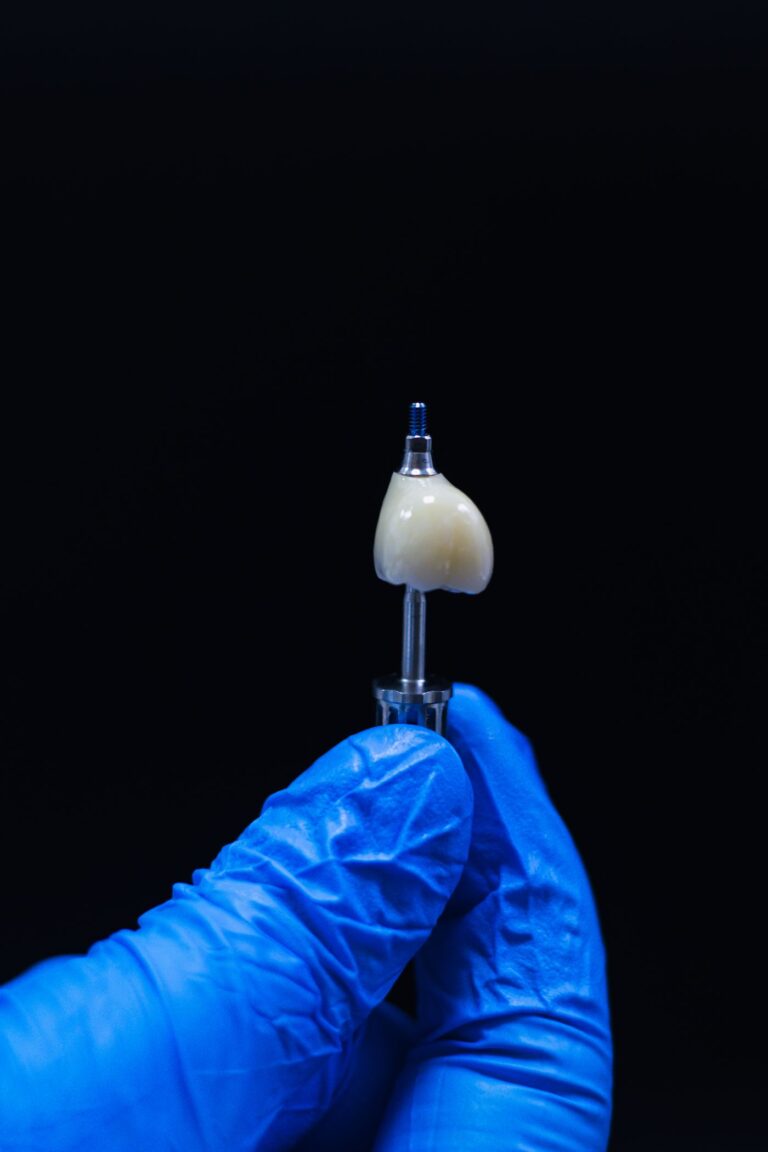
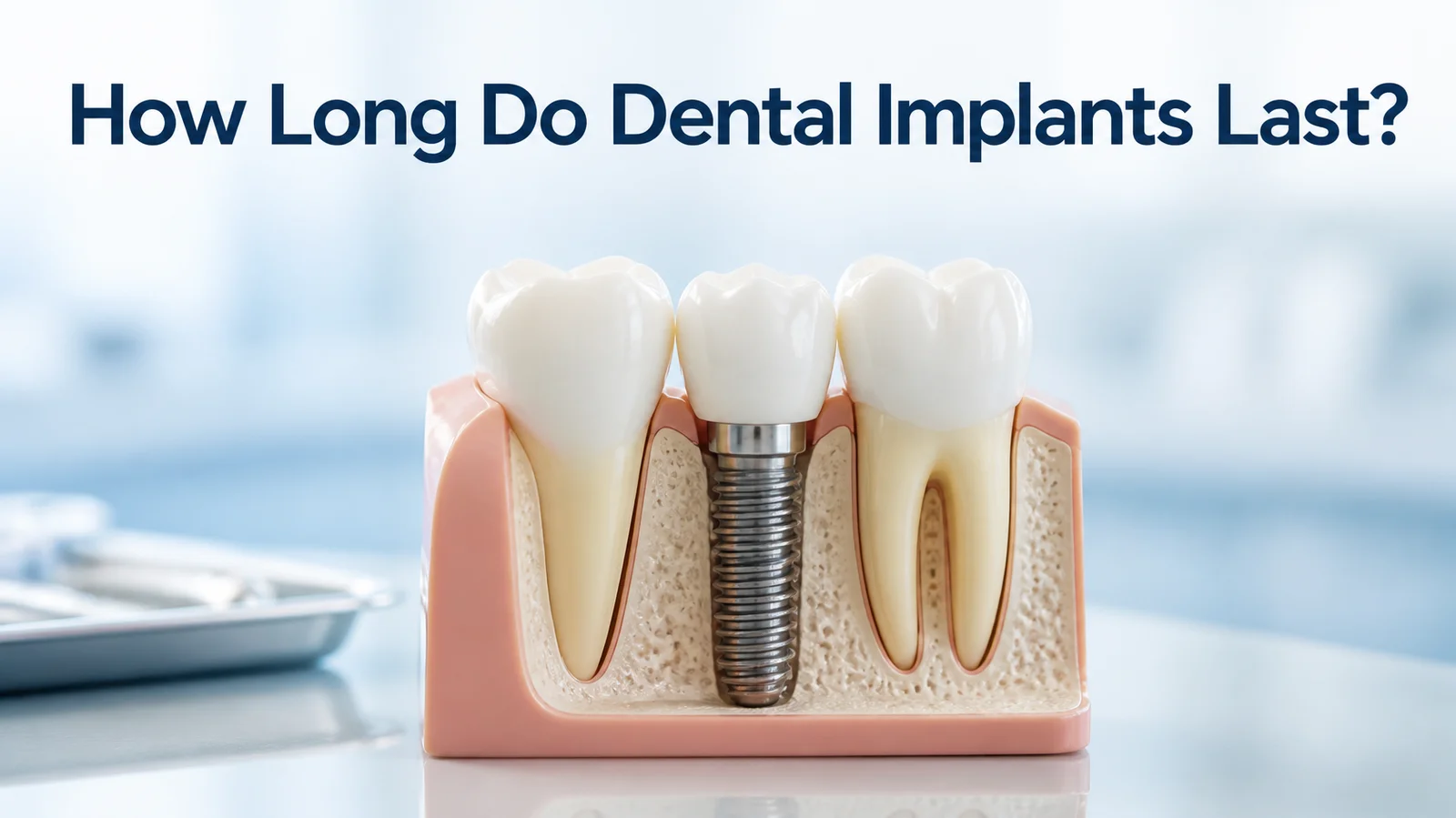

A dental implant is a titanium post placed in the jaw to replace the root of a missing tooth, and it supports a crown, a bridge or a denture. The implant post can often last a lifetime with good brushing, flossing and regular dental visits, while the crown on top usually lasts around 15 years.
On this page24 sections
- How Long Do Dental Implants Last?
- Quick Answer: How Long Do Dental Implants Last?
- Introduction
- The Implant and the Crown Have Different Lifespans
- The Titanium Implant Post
- The Abutment
- The Crown on Top
- What the Long-Term Research Shows
- What Makes Dental Implants Last Longer — or Fail Earlier?
- Gum Health and Peri-Implantitis
- Teeth Grinding and Bite Forces
- Smoking, Diabetes, and General Health
- Daily Cleaning and Regular Dental Visits
- Signs Your Dental Implant May Need Attention
- How to Help Your Dental Implants Last Longer
- Dental Implants vs Dentures and Bridges: How Long Does Each Last?
- When to See a Dentist in Lake Mary About an Implant
- Frequently Asked Questions
- Do dental implants last forever?
- How long do dental implants last, and how long does the crown on an implant last?
- Can a dental implant fail after many years?
- Do dental implants need special cleaning?
- How often should implants be checked?
- Final Thoughts
How Long Do Dental Implants Last?
Quick Answer: How Long Do Dental Implants Last?
At Orlando Healthy Smiles in Lake Mary, Florida, Dr. Akmal Ahmed, DDS, places dental implants with Nobel Biocare, Straumann, Neodent, Megagen, Osstem, MIS and Envista systems, using titanium or zirconia posts. A dental implant is a titanium post that replaces a missing tooth root, and the crown on top is a separate part. A dental implant post can often last a lifetime with good brushing, flossing and regular dental visits, while the crown on top usually lasts around 15 years. Call Orlando Healthy Smiles at (407) 790-4181 for dental implants in Lake Mary, FL: Dr. Akmal Ahmed checks the bone, plans the implant and crown, and reviews your implant at routine visits. A dental implant is a titanium post placed in the jaw to replace a missing tooth root, supporting a crown, a bridge or a denture. The titanium implant post can often last a lifetime with good brushing, flossing, and regular dental visits, according to Cleveland Clinic. The crown on top usually lasts less time. Most crowns and bridges last around 15 years, Cleveland Clinic notes. So the honest answer depends on which part you mean: the post, the crown, or the whole restoration together.
That difference matters. Many people ask how long will a dental implant last and expect one number. In real life, the dental implant lifespan has two parts. The post sits in the jawbone and can last for decades. The crown takes the daily work of chewing and may need replacement sooner. Good care protects both parts.
Introduction
If you are thinking about a dental implant, or you already have one, it makes sense to ask about longevity before you decide. This guide explains the longevity of dental implants in plain language: how long the post and the crown usually last, what long-term research shows, what helps implants last longer, and the signs of dental implant failure. The figures here are ranges from published research and Cleveland Clinic guidance, not promises for one person.
The Implant and the Crown Have Different Lifespans
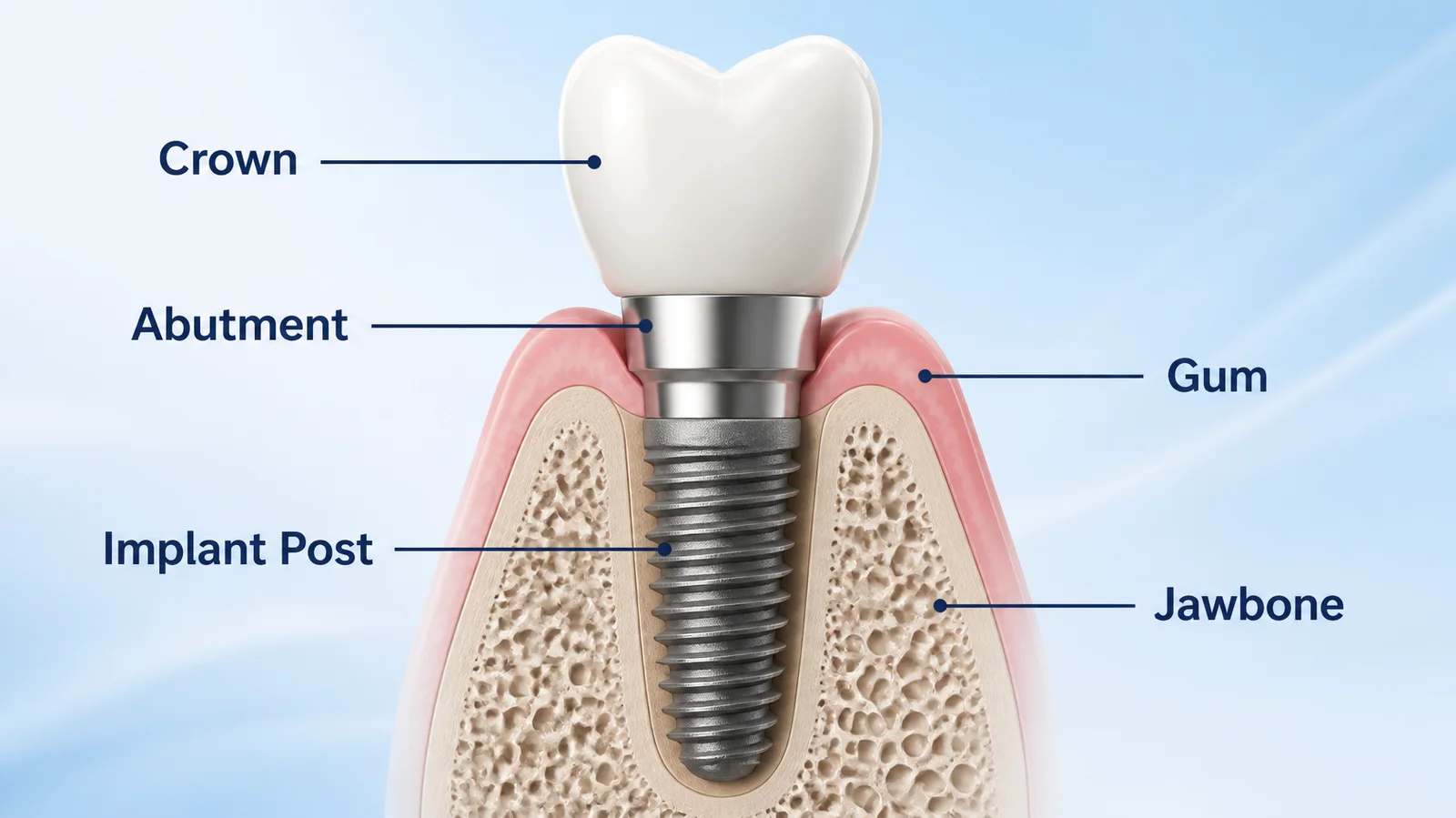
A dental implant is not one solid piece. It has parts, and each part has a different job and a different expected life.
The Titanium Implant Post
The post is a small titanium screw — a Nobel Biocare, Straumann, Neodent, Megagen, Osstem, MIS or Envista implant post — that Dr. Akmal Ahmed places in the jawbone. Over time, the bone grows around it in a process called osseointegration. This bond gives the implant its strength and stability. The post does not chew food directly, and it does not decay like a natural tooth. With healthy gums, good bone support, and regular care, the post can often last a lifetime. That is why people ask, “Do dental implants last forever?” The post can come close, but no dentist can promise a lifetime result for every patient.
The Abutment
The abutment is the small connector between a Nobel Biocare, Straumann, Neodent, Megagen, Osstem, MIS or Envista implant post and the crown. It sits above the gum line and holds the crown in place. It usually lasts as long as the post, unless it loosens or needs adjustment. Dr. Akmal Ahmed can often tighten or replace an abutment without replacing the whole implant.
The Crown on Top
The crown is the visible tooth. It looks and works like a natural tooth, and it takes the full force of chewing. Porcelain crowns on a Nobel Biocare, Straumann, Neodent, Megagen, Osstem, MIS or Envista implant typically last 10 to 15 years. They can chip, crack, or wear down over time, especially if you grind your teeth. When a crown wears out, the titanium or zirconia post below it may still be healthy, and Dr. Akmal Ahmed can replace the crown and keep the original implant post. That is why the life expectancy of dental implants is often limited by the crown, not by the post.
What the Long-Term Research Shows
Researchers follow large groups of implants for many years and count how many are still in place. A systematic review by Howe and colleagues in 2019 reported 10-year implant survival of about 96.4%. A large cohort study of 10,871 implants reported survival of 98.5% at 5 years, 96.8% at 10 years, and 94.0% at 15 years.
How often do dental implants fail? Based on these figures, failure is uncommon, but it is not zero. The risk is highest in the first months, while the implant is healing and joining with the bone. After that early period, the risk drops, but it does not disappear. Gum infection around an implant, called peri-implantitis, is one of the main long-term risks. These are group results; they do not predict what will happen for one person.
What Makes Dental Implants Last Longer — or Fail Earlier?
Several factors affect how long teeth implants last. Some you can control. Others need help from your dentist.
Gum Health and Peri-Implantitis
Healthy gums protect the bone around an implant. When plaque builds up, the gums can become inflamed, and if that inflammation reaches the bone, it can cause peri-implantitis, which can loosen the implant over time. Daily brushing and flossing, plus regular professional cleanings, help keep plaque under control. If your gums bleed often or pull away from the implant crown, tell your dentist.
Teeth Grinding and Bite Forces
Grinding or clenching puts extra force on the crown and the implant. Over time, that force can crack a crown, loosen parts, or stress the bone. If you wake up with a sore jaw, mention it. A night guard can reduce the force and protect the implant.
Smoking, Diabetes, and General Health
Smoking slows healing and raises the risk of gum infection around implants. Diabetes also affects healing, especially when blood sugar is not well controlled. Tell your dentist about your health history and any medicines you take, so care can be planned to fit your situation.
Daily Cleaning and Regular Dental Visits
Dental implant aftercare is simple, but it needs to happen every day. Brush twice a day with a soft brush, clean around the implant crown carefully, and use interdental brushes or a water flosser for hard-to-reach areas if your dentist suggests them. Regular dental visits matter too: your dentist can check the implant, the crown, your bite, and your gums, and small problems are easier to fix when found early.
Signs Your Dental Implant May Need Attention
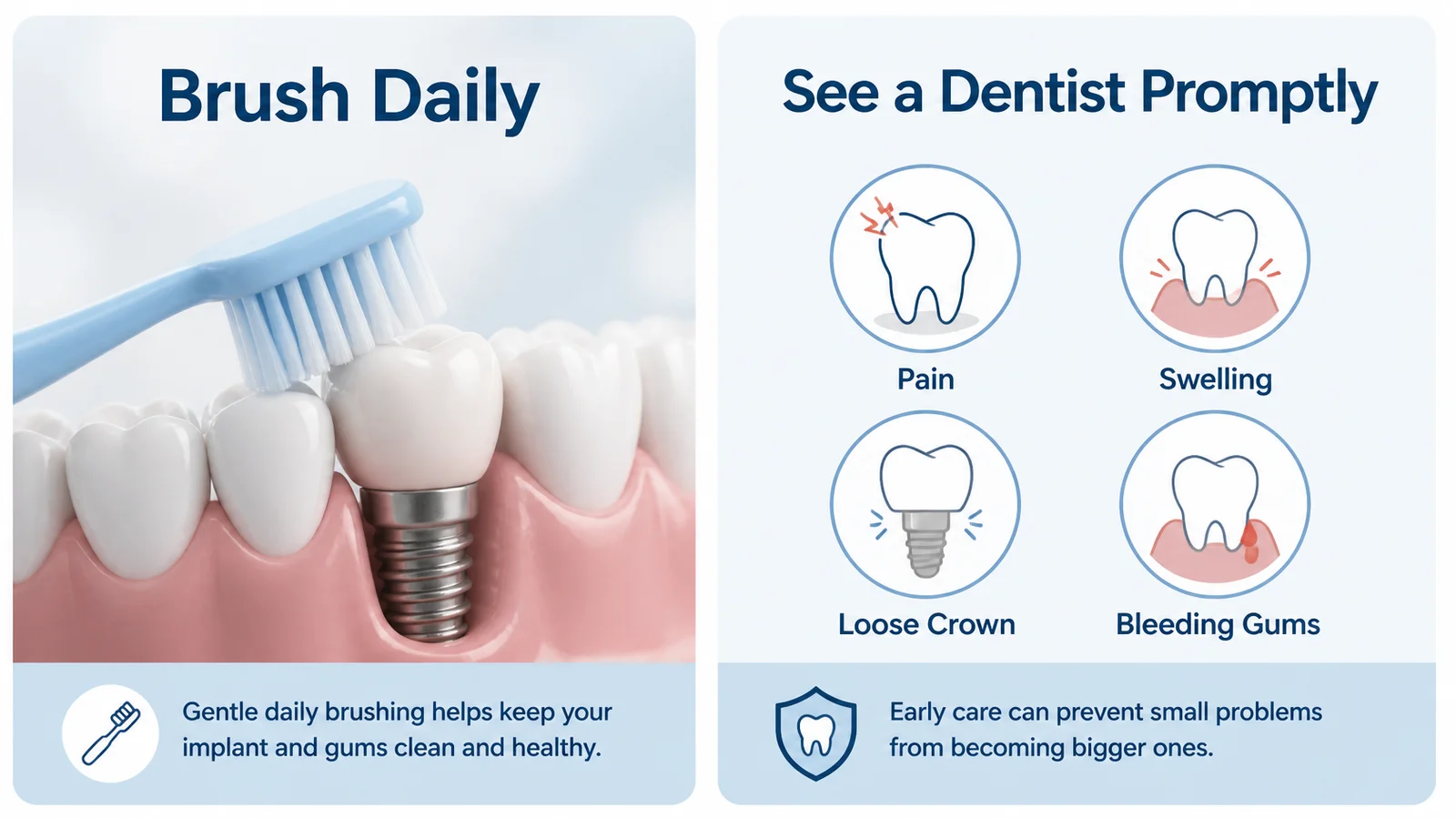
Most implants feel normal once they heal. You should not feel pain when you chew, and the crown should not move. Signs of dental implant failure or trouble include pain around the implant, swelling or redness in the gums, bleeding that does not stop, a loose crown, a bad taste, or pus near the implant. A change in how your bite feels can also be a warning sign. Some problems start slowly, so regular check-ups matter: your dentist can spot bone loss or gum changes before you feel them. If you notice any of these signs, contact your dentist promptly. Early treatment can sometimes save the implant.
How to Help Your Dental Implants Last Longer
Good habits make a real difference. They do not guarantee a lifetime result, but they give your implant the best chance. Brush your implant crown the same way you brush natural teeth, twice a day, and floss or use interdental brushes daily. Avoid using your teeth to open packages or crack hard objects, and wear a mouthguard for contact sports. Keep your dental visits regular, follow the plan your dentist suggests, and tell your dentist if anything changes between visits. If you grind your teeth, smoke, or have diabetes, talk with your dentist about extra steps.
Dental Implants vs Dentures and Bridges: How Long Does Each Last?
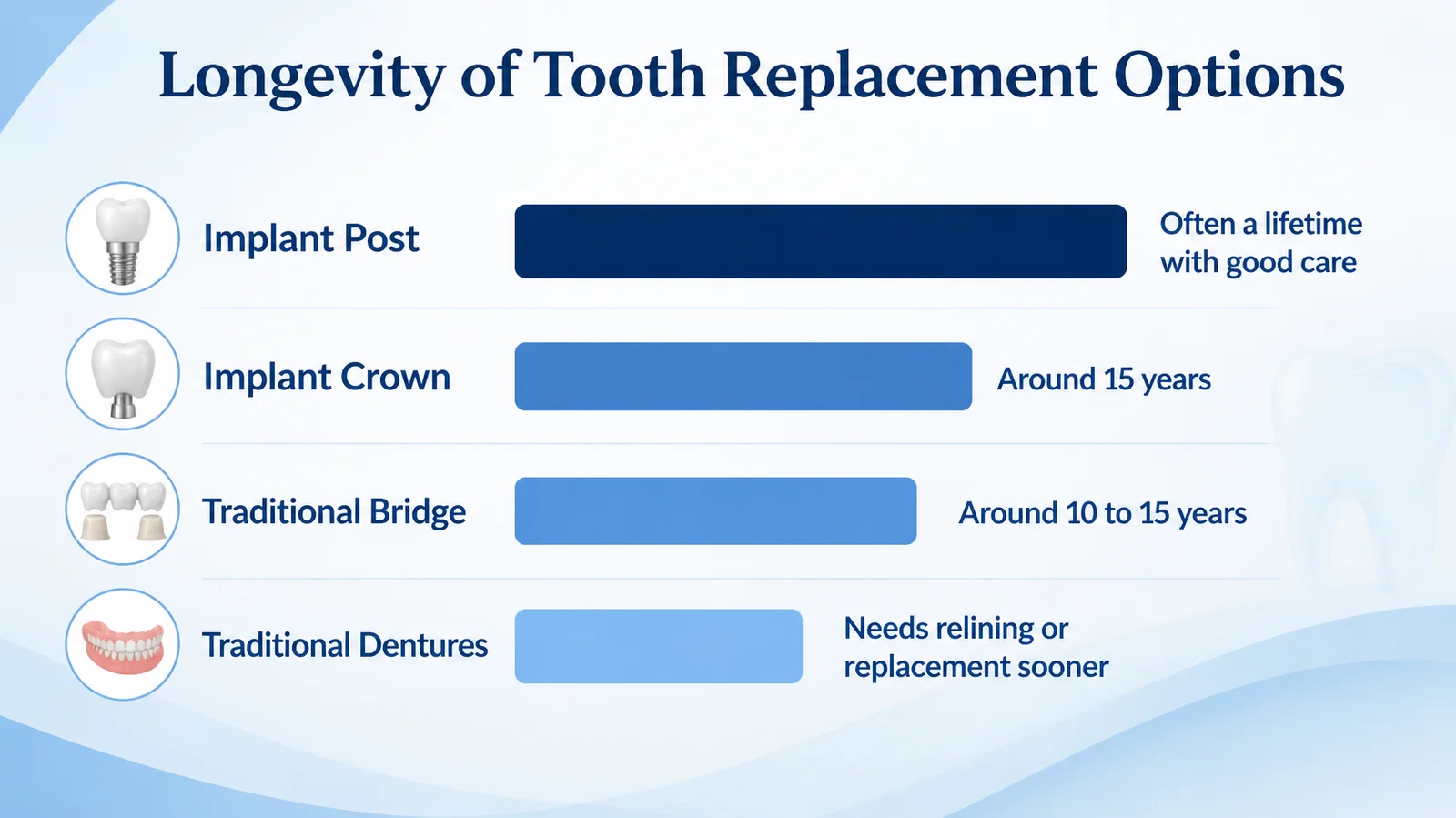
If you are comparing options, lifespan is only one part of the decision. Comfort, stability, bone health, and maintenance also matter.
| Option | Typical lifespan | What usually wears out first |
|---|---|---|
| Titanium or zirconia implant post (Nobel Biocare, Straumann, Neodent, Megagen, Osstem, MIS, Envista) | Often a lifetime with good care | Gum and bone health around the post |
| Porcelain crown on an implant abutment | Porcelain crowns typically 10–15 years | The crown itself, from chewing and wear |
| Traditional dentures | Often need relining or replacement sooner than an implant post | Fit changes as the jaw and gums change |
| Traditional bridge | Often around 10–15 years, similar to a crown | The supporting teeth or the bridge itself |
Dental implants help preserve jawbone because the post stimulates the bone, much like a natural tooth root. Dentures rest on the gums and do not provide the same bone stimulation. Bridges rely on nearby teeth for support.
If you want to learn more about the implant option itself, read the Dental Implants service page. For the removable option, see the Dentures service page. For crowns and bridges, see the Restorative Dentistry service page. For routine exams and cleanings that support implant health, see the Family Dentistry service page.
When to See a Dentist in Lake Mary About an Implant
You should see a dentist if you are thinking about replacing a missing tooth, if you have an implant that hurts or feels loose, or if your gums around an implant bleed or swell. You should also see a dentist if your implant crown chips, cracks, or feels different when you bite. A dentist can examine the implant, check your gums and bite, and take X-rays if needed. If you live in Lake Mary or a nearby community such as Heathrow, Sanford, or Longwood, the team at Orlando Healthy Smiles can help you explore appropriate next steps.
Have questions about your dental implant?
If you are considering an implant, or you want an existing implant checked, a dentist can review your situation and talk through your options. Request a dental appointment in Lake Mary.
Frequently Asked Questions
Do dental implants last forever?
No dentist can promise that a dental implant will last forever for every patient. The titanium post can often last a lifetime with good care, according to Cleveland Clinic, while the crown usually lasts 10 to 15 years.
How long do dental implants last, and how long does the crown on an implant last?
Porcelain crowns typically last 10 to 15 years. Chewing, grinding, and normal wear can shorten that time. If the crown wears out but the post is still healthy, a dentist can often replace the crown alone.
Can a dental implant fail after many years?
Yes, it can, although it is uncommon. Most failures happen early, during healing. Later failure is often linked to gum infection, heavy grinding, smoking, or uncontrolled diabetes.
Do dental implants need special cleaning?
Dental implants need the same daily care as natural teeth, plus careful cleaning around the crown. Brush twice a day, clean between teeth daily, and keep your professional cleanings and check-ups regular.
How often should implants be checked?
Ask your dentist. Many people have their implants checked at routine dental visits, often every six months. If you have gum disease, grind your teeth, or have other risk factors, your dentist may suggest more frequent visits.
Final Thoughts
How long do dental implants last? The post can often last a lifetime with good care, while the crown usually lasts 10 to 15 years. Long-term research supports that pattern, with high survival rates at 5, 10, and 15 years. Good daily care, healthy gums, and regular dental visits give your implant the best chance to last.
This article from Dr. Akmal Ahmed at Orlando Healthy Smiles in Lake Mary, Florida, provides general information only. It is not a diagnosis and does not replace advice from your own dentist. Individual results vary. If you have pain, swelling, or another dental concern, seek professional care promptly.